
SPECT/CT may represent a practical alternative to PET/CT for primary staging in patients with high-risk prostate cancer, according to a study published July 22 in EJNMMI Research.
The finding is from a phase II prospective study that compared technetium-99m (Tc-99m)-MIP-1404 CZT SPECT/CT versus gallium-68 (Ga-68) prostate-specific membrane antigen (PSMA)-11 PET/CT among 33 patients with newly diagnosed disease, noted lead author Aws Saudi, MD, of Linköping University in Sweden, and colleagues.
“Considering its broader accessibility, Tc-99m MIP-1404 CZT SPECT/CT may represent a practical alternative for primary staging, especially in settings with limited PET/CT availability,” the group wrote.
PSMA PET/CT has demonstrated superior accuracy for primary prostate cancer staging compared with conventional imaging, but access is constrained by cyclotron requirements, generator dependency, and costs up to three to four times higher than SPECT/CT, the authors explained. The development of Tc-99m-based PSMA-targeted agents may offer a potential route to PSMA-quality staging in settings where PET/CT infrastructure is limited, they hypothesized.
To test the technique, the researchers prospectively enrolled 33 men aged over 50 years old with newly diagnosed high-risk prostate cancer between January 2023 and December 2024. All participants underwent three scans within a 30-day interval: Ga-68-PSMA-11 PET/contrast-enhanced (CE) CT, Tc-99m MIP-1404 CZT SPECT/CT, and Tc-99m HDP CZT SPECT/CT (bone scan). Images were analyzed using the prostate-specific membrane antigen reporting and data system (PSMA-RADS) version 2.0.
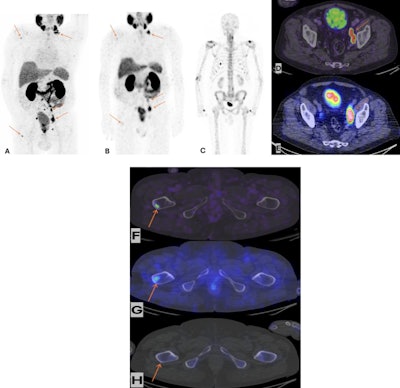
 Maximum intensity projection of Ga-68 PSMA-11 PET/CE-CT (A), Tc-99m MIP-1404 CZT SPECT/CT (B) and Tc-99m HDP CZT SPECT/CT (C) imaging. Ga-68 PSMA-11 PET/CE-CT and Tc-99m MIP-1404 CZT SPECT/CT showing tracer uptake in lymph nodes below the iliac bifurcation and above, paraaortic and left supraclavicular, bone uptake in the right proximal femur and right scapula (arrows). Tc-99m HDP CZT SPECT/CT did not show any uptake suspicious for metastatic disease. No sclerotic lesions suspicious of metastases were detected by the CT component in any of the studies. Fusion axial imaging of Ga-68 PSMA-11 PET/CE-CT (D) and Tc-99m MIP-1404 CZT SPECT/CT (E) showing uptake in lymph nodes in the left pelvic area below the iliac bifurcation (arrows). Fusion axial imaging of Ga-68 PSMA-11 PET/CE-CT (F) and Tc-99m MIP-1404 CZT SPECT/CT (G) showing uptake in the right proximal femur, not detected by Tc-99m HDP CZT SPECT/CT (H), (arrows). EJNMMI ResearchAccording to the results, at the patient level, sensitivity of Tc-99m MIP-1404 CZT SPECT/CT for metastasis detection was 81% for lymph node (LN) metastasis and 85% for bone metastases, compared with 57% for conventional bone scans. There were no false positive findings Tc-99m MIP-1404 CZT SPECT/CT and its specificity was 100% compared to Ga-68 PSMA-11 PET/CE-CT.
At the lesion level, Ga-68-PSMA-11 PET/CE-CT detected significantly more lymph node metastases than Tc-99m MIP-1404 SPECT/CT (mean 8.19 versus 2.09 per patient; p
Lastly, therapy decisions based on Tc-99m MIP-1404 CZT SPECT/CT were concordant with those based on Ga-68 PSMA-11 PET/CE-CT in 91% (30/33) of patients.
“It is important to highlight that despite the higher lesion count with Ga-68 PSMA-11 PET/CT, this did not translate into a meaningful change in treatment decisions in our study cohort,” the group wrote.
Further studies with larger cohorts are needed to strengthen its diagnostic performance and confirm the potential of Tc-99m MIP-1404 CZT SPECT/CT, the researchers concluded.
Read the full study here.
Whether you are a professional looking for a new job or a representative of an organization who needs workforce solutions - we are here to help.