
PET/MRI is a noninvasive, high-precision tool for identifying patients with high-risk atherosclerotic plaques, according to research presented May 14 at the ISMRM meeting in Cape Town, South Africa.
The finding is from a study that evaluated MRI, PET, and integrated PET/MRI for distinguishing symptomatic from asymptomatic carotid plaques among 145 patients, using both conventional features and radiomics, noted presenter Qian Li, PhD, of the Chinese Academy of Sciences in Shenzhen, and colleagues.
“These findings highlight the synergistic value of combining structural (MRI) and functional (PET) data, demonstrating that this integrated approach significantly improves the precision of high-risk plaque detection and risk stratification,” the group wrote.
Carotid atherosclerosis is a major cause of ischemic stroke, making early identification of vulnerable plaques a clinical priority. Hybrid PET/MRI enables the simultaneous acquisition of metabolic and anatomical data by combining the molecular sensitivity of PET and the tissue contrast of MRI. However, current studies have not fully exploited this technology, the researchers noted, focusing instead on basic MRI features or simple PET uptake metrics such as maximum standardized uptake value (SUVmax) and target-to-background ratio (TBR).
To bridge the gap, the group gathered data from 145 patients with advanced carotid plaques -- 52 with symptomatic and 93 with asymptomatic plaques -- who underwent hybrid F-18 FDG-PET/MRI scans between September 2022 and January 2025. They extracted seven conventional MRI morphological features (intraplaque hemorrhage, lipid-rich necrotic core, ruptured fibrous cap, calcification, surface ulceration, and plaque enhancement) and three standard PET metabolic parameters -- metabolic uptake, SUVmax, and TBR -- were evaluated. Next, they extracted 1,991 radiomics features from each of the MRI and PET images and then, for each modality, they developed three types of models: conventional, radiomics, and combined (incorporating conventional and radiomic features).
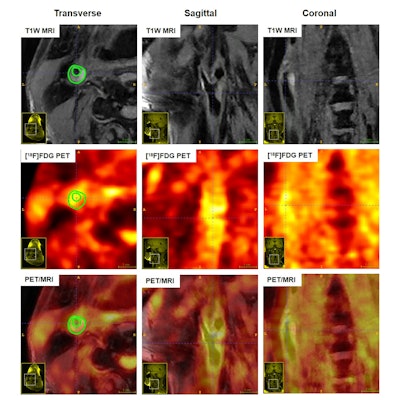
 Multimodality imaging (MRI, PET, and fused PET/MRI) of carotid artery plaques in asymptomatic and symptomatic subjects, illustrating distinct features of surface ulceration, plaque enhancement, metabolic uptake, and SUVmax. Qian Li, PhD, and ISMRMIn the MRI-based analysis, surface ulceration and plaque enhancement emerged as independent predictors of symptomatic plaques. In the PET-based analysis, SUVmax and metabolic uptake were identified as significant independent predictors. In testing, the PET conventional model outperformed the MRI conventional model in distinguishing symptomatic from asymptomatic carotid plaques, with an area under the curve (AUC) of 0.92 vs. 0.82 (p
“Integrated conventional MRI features, PET metabolic parameters, and advanced radiomics from both PET and MRI improve the noninvasive identification of high-risk plaques and enhance cerebrovascular risk stratification,” the group wrote.
Future work should focus on expanding patient cohorts and incorporating deep learning strategies to automate and optimize model development, thereby accelerating the clinical translation of this promising approach, the researchers concluded.
Check out AuntMinnie’s full coverage of ISMRM 2026 on our ShowCast.
Whether you are a professional looking for a new job or a representative of an organization who needs workforce solutions - we are here to help.