
A multimodal composite combining MRI, blood biomarkers, and cardiovascular measures showed stronger associations with Alzheimer's dementia (AD) than PET amyloid imaging, researchers reported at the recent ISMRM 2026 meeting.
"[Our] findings demonstrate that reproducible, multimodal composites can capture distinct yet complementary dimensions of brain health," noted a team led by PhD candidate Ella Rowsthorn of Monash University in Melbourne, Australia.
Brain stability depends on complex, interconnected systems such as the neurovascular unit and fluid clearance pathways, the group explained, but individual biomarkers capture only particular aspects of these systems' function. That's why "multivariate, system-level frameworks may provide better insight into broader domains of brain health and may offer avenues to risk-stratify for dementia," it wrote.
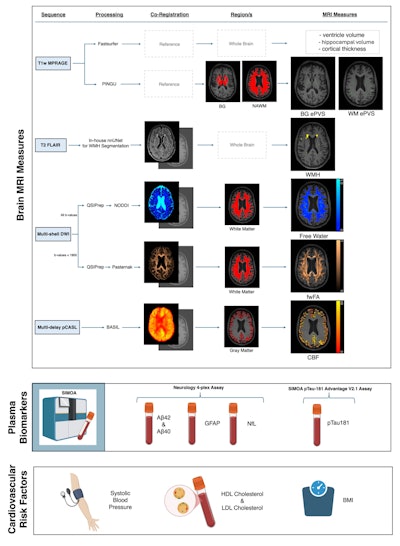
Rowsthorn and colleagues sought to identify any hidden patterns of brain health that could underlie multimodal biomarkers in older adults. They validated these patterns in an independent cohort and investigated any associations between cognition and clinical diagnosis of mild cognitive impairment (MCI) and AD dementia. The research included 127 participants from the Brain and Cognitive Health (BACH) cohort study (a prospective study of community-dwelling older adults without dementia; mean age 67 years, 68% women). The team tracked 10 brain MRI measures, four plasma biomarkers, and four cardiovascular risk indices.
The group described four "brain health composites" that represented particular domains:
The researchers then performed a validation process that included 222 participants from the Prospective Imaging Study of Ageing, or PISA trial (mean age 63 years, 73% women). Of these 222 participants, 180 were cognitively normal, 19 had MCI, and 23 had AD dementia.
Rowsthorn and colleagues reported the following:
 Illustrative summary of MRI analysis pipeline, plasma biomarkers, and cardiovascular risk measures included in the exploratory factor analysis.Ella Rowsthorn and ISMRM
The group noted that the brain health composites are not disease-specific, and thus offer "a framework to probe fundamental domains of brain health, reduce measurement noise inherent to individual markers, and integrate complementary information from MRI and biofluid measures."
"Future research should assess the applicability of these constructs across neurological and systemic diseases and characterize how composite scores change with age or disease progression," the team concluded.
Check out AuntMinnie’s full coverage of ISMRM 2026 on our ShowCast.
Whether you are a professional looking for a new job or a representative of an organization who needs workforce solutions - we are here to help.