


PET/MRI may offer a path toward diagnosing prostate cancer without biopsies, according to a study published July 2 in the Journal of Nuclear Medicine.
The finding is from an analysis that included 79 men with suspected clinically significant prostate cancer who underwent F-18 flotufolastat PET/MRI scans at least 90 days before biopsy or radical prostatectomy, noted lead author Türkay Hekimsoy, MD, of the Technical University of Munich, and colleagues.
“In our cohort, prostate biopsy would have been avoided in 57% of patients,” the group wrote.
Approximately one million prostate biopsies are performed annually in the U.S., a volume associated with considerable morbidity, including pain, rectal bleeding, prostatitis, and urinary tract infections, the authors noted. Multiparametric MRI assessed by PI-RADS scoring can already spare some patients from biopsy, but its specificity and positive predictive value remain limited, the authors noted.
Prostate-specific membrane antigen (PSMA) PET with radiotracers such as F-18 flotufolastat (Posluma, Blue Earth Diagnostics) can achieve high specificity at elevated tracer uptake thresholds (SUVmax), and the authors hypothesized that combining both parameters could further reduce the need for the invasive procedure.
The group analyzed data from 79 patients with suspicion of clinically significant prostate cancer based on elevated prostate-specific antigen (> 4 ng/mL) who underwent F-18 flotufolastat PET/MRI (Biograph mMR; Siemens Healthineers) at their center between November 2018 and October 2024. All patients had disease confirmation via biopsy or radical prostatectomy within 90 days of imaging. Of 79 patients, 42 were ultimately diagnosed with clinically significant prostate cancer (csPCa) and 37 were not.
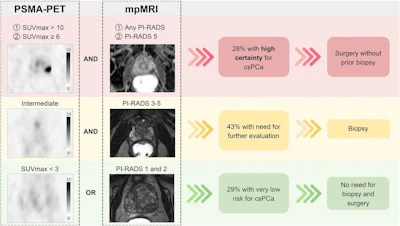 A visual abstract of the study.Journal of Nuclear MedicineAccording to the analysis, combining PI-RADS and SUVmax achieved an area under the curve of 87%, outperforming PI-RADS alone (75%) and SUVmax alone (81%). At an SUVmax threshold above 10, F-18 flotufolastat PET achieved 100% specificity and correctly identified 17 patients with confirmed csPCa and generated no false positives. Incorporating PI-RADS allowed that high-specificity threshold to be lowered for patients with PI-RADS scores of 4 or 5 and expanded the high-confidence positive group to 22 patients.
Further, 23 patients were classified as having a very low likelihood for csPCa based on a PI-RADS score of 2 or lower or an SUVmax below 3, with a false-negative rate of approximately 10%. Combined, the two groups represented 57% of the cohort for whom biopsy could potentially have been avoided, compared with 25% achievable with MRI alone, the researchers reported.
“PET/MRI can stratify patients with suspected prostate cancer into three groups: one with a very high likelihood of csPCa who may undergo definitive therapy without biopsy, one with a very low risk for csPCa who may not require biopsy, and an indeterminate group who still need biopsy,” the group wrote.
Ultimately, the findings warrant prospective studies of PSMA PET/MRI to reduce the number of unnecessary biopsies in men with suspected disease, the researchers concluded.
The full study is available here.
Whether you are a professional looking for a new job or a representative of an organization who needs workforce solutions - we are here to help.