
An experimental PET tracer that targets an enzyme on cancer cells called carbonic anhydrase IX (CAIX) shows promise in patients with clear cell renal cell carcinoma (ccRCC), according to a recent study.
A team at the Chinese PLA General Hospital in Beijing evaluated gallium-68 (Ga-68) DPI-4452 PET/CT scans in 30 adults with suspected renal masses scheduled for surgery or biopsy, with findings suggesting the approach may aid in noninvasive ccRCC characterization and detection of metastatic disease.
“Our study demonstrated that CAIX-targeted Ga-68 DPI-4452 PET/CT provides robust primary tumor identification and detects additional metastatic lesions compared with conventional imaging,” noted lead authors Dongxing Wang, MD, and Lei Du, MD, and colleagues. The study was published September 10 in the Journal of Nuclear Medicine.
Accurate preoperative characterization and disease staging in patients with ccRCC are critical but remain challenging with conventional contrast-enhanced CT and MRI, which rely on morphologic criteria and frequently underestimate small metastases, the authors explained. Conversely, Molecular imaging offers the potential to overcome these limitations, and early clinical findings with Ga-68 DPI-4452 PET/CT have been encouraging, they added.
To further assess the tracer’s diagnostic efficacy and its incremental value for detecting metastatic disease, the researchers enrolled 30 adults with suspected renal masses scheduled for surgery or biopsy in a prospective trial. Histopathology served as the reference standard for primary lesions, while metastatic lesions were validated by histopathology or composite clinicoradiologic follow-up of at least three months. Two experienced nuclear medicine physicians independently reviewed all images.
According to the results, histopathology confirmed 23 ccRCC cases and seven non-ccRCC or benign lesions. Ga-68 DPI-4452 PET/CT correctly identified all 23 primary ccRCC tumors, achieving 100% sensitivity and a specificity of 85.7%, with an overall accuracy of 97%. No tracer-related adverse events occurred, the researchers reported.
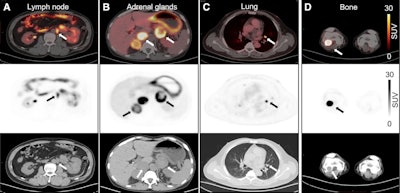
 Representative Ga-68 DPI-4452 PET/CT images of regional and distant metastases in ccRCC from multiple patients, including regional lymph node (A), bilateral adrenal glands (B), lung (C), and bone (D). For each panel, top row shows fused PET/CT images, middle row shows PET-only images, and bottom row shows unenhanced CT images. Target lesions are highlighted by white arrows on fused/CT images and black arrows on PET images.Journal of Nuclear MedicineFor metastatic disease, conventional imaging identified 23 lesions among the 23 patients with confirmed ccRCC. Ga-68 DPI-4452 PET/CT detected 20 additional lesions that conventional imaging missed, increasing the absolute metastatic yield by 82.6%, from 23 to 42 lesions. Sensitivity for extrarenal metastases reached 97.7%.
“Ga-68 DPI-4452 PET/CT may aid in noninvasive ccRCC characterization and detection of metastatic disease,” the researchers wrote.
The findings add to a growing evidence base for CAIX-targeted molecular imaging in ccRCC, though the tracer's physiologic expression in gastrointestinal tissue may complicate image interpretation and could pose challenges for eventual CAIX-targeted theranostic applications, the group noted.
“Multicenter validation is required before this CAIX-targeted approach can be integrated into routine diagnostic algorithms,” the researchers concluded.
The full study is available here.
Whether you are a professional looking for a new job or a representative of an organization who needs workforce solutions - we are here to help.