


A risk classification system can help predict cancer in cystic renal masses from CT and MRI exams, according to research published September 29 in Radiology.
The 2019 version of the Bosniak risk classification system can predict renal cancer with unfavorable histologic features, with nodule size having strong ties to unfavorable histologic features, wrote a team led by Justin Tse, MD, from Stanford University in California.
“Accordingly, nodule size should be explicitly reported and incorporated during shared decision-making because it offers clinically meaningful risk stratification beyond Bosniak class alone,” Tse and colleagues wrote.
The Bosniak system has been used to help predict the likelihood of cancer in cystic renal masses. Bosniak class I and II masses are benign and do not require follow-up. Bosniak IIF masses are tied to low cancer risk, while Bosniak III and IV masses indicate moderate and high cancer risk, respectively.
However, it’s not known whether the system also can help predict cancer with unfavorable histologic features. The researchers noted that most cystic renal cancers are indolent.
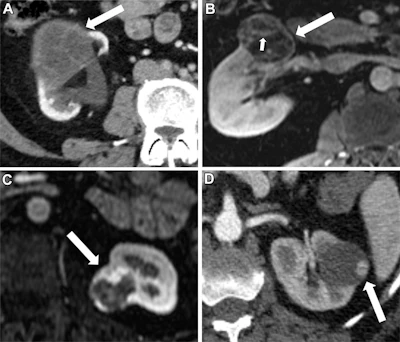 Example subclasses of Bosniak III and Bosniak IV according to Bosniak Classification version 2019 criteria. (A) Contrast-enhanced CT scan in a 55-year-old female patient with a Bosniak III subclass mass with thickened (≥4 mm) smooth walls or septa in the lower pole of the right kidney (arrow), (B) contrast-enhanced MRI scan in a 45-year-old male patient with a Bosniak III subclass mass with an obtuse protrusion (≤3 mm) in the interpolar right kidney (arrows), (C) contrast-enhanced MRI scan in a 51-year-old female patient with a Bosniak IV subclass mass with an obtuse protrusion (≥4 mm) in the interpolar left kidney (arrow), and (D) contrast-enhanced CT image in a 55-year-old female patient with a Bosniak IV subclass mass with acutely angulated protrusions in the interpolar right kidney (arrow).RSNA
The Tse team studied whether Bosniak version 2019 and cystic mass nodule size help predict cancer and cancer with unfavorable histologic features. It also compared the accuracy of Bosniak class III and IV subclassifications.
The retrospective study included 419 patients with 421 masses labeled either Bosniak III or IV. The patients were treated across 10 institutions and three countries between 2007 and 2024. Two radiologists at each site independently reviewed pretreatment renal CT or MRI scans gathered within one year of resection.
Bosniak IV masses had showed higher probability of cancer and cancer with unfavorable histologic features.
Probabilities of cancer from cystic renal masses by Bosniak classification | ||
Measure | Bosniak III | Bosniak IV |
Probability of cancer | 74.8% | 91.0% |
Probability of cancer with unfavorable histologic features | 10.3% | 32.3% |
The team found no evidence of a difference in the odds of cancer or unfavorable histologic features within the Bosniak III (p = 0.56 to 0.99) or IV (p = 0.10 to 0.50) subclasses.
Nodule size emerged as the strongest predictor of cancer (odds ratio [OR], 4.1 per 10 mm; p = 0.001) and unfavorable histologic features (OR, 1.9 per 10 mm; p
Finally, interrater agreement proved to substantial for Bosniak class (Gwet AC1, 0.70) and good for nodule size (intraclass correlation coefficient, 0.89).
The results show that Bosniak classification version 2019 can be used to stratify the probability of cancer and cancer with unfavorable histologic features.
“With the development of automated techniques, the additive effect of multiple nodules on the probability of cancer can be evaluated in future studies,” the study authors wrote.
Read the full study here.
Whether you are a professional looking for a new job or a representative of an organization who needs workforce solutions - we are here to help.