


Functional MRI (fMRI) shows how music can affect the flavor of food, according to research published in Scientific Reports.
Brain scans reveal stronger neurological responses when music plays while people eat than when taste is experienced without music, wrote a team led by Alberte Seeberg, PhD, from the University of Copenhagen.
“These findings provide novel insight into the neural basis of sound–taste interactions and contribute to our understanding of how auditory cues can shape flavor perception through multisensory integration,” the Seeberg team wrote.
Sonic seasoning is a phenomenon described in emerging research as how music or soundscapes can be intentionally used to modify the perceived taste, aroma, mouthfeel, or flavor of foods and beverages. Recent neuroimaging studies also show that contextual cues can adjust sensory processing.
Seeberg and colleagues studied how music influences brain activity for taste. They collected fMRI scans and behavioral data from 28 participants across three conditions: taste only, music only, and music–taste combinations.
Participants received sweet and sour beverages while in the scanner, accompanied by musical soundtracks composed to convey sweetness or sourness. The participants rated each stimulus or combination for pleasantness, intensity, and sound–taste congruency.
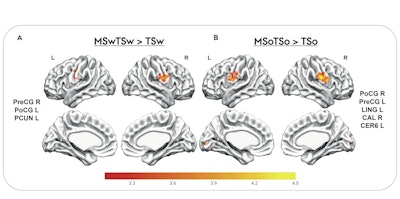
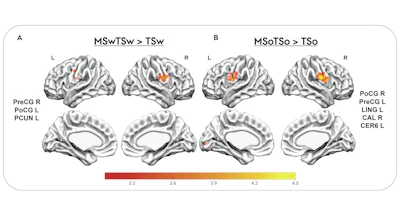 The figure shows what happens in the brain when taste is combined with music. On the left (A), sweet taste is paired with music associated with sweetness and compared with sweet taste alone. On the right (B), the same comparison is shown for sour taste. The yellow and orange areas indicate regions where the brain responds more strongly when music and taste are experienced together. These include areas involved in processing taste and sensory signals from the mouth. The findings show that what we hear can influence how the brain processes what we taste.Seeberg et al
The brain scans revealed that sweet and sour music and taste experiences activated many of the same brain regions, particularly in areas around the peri-rolandic and medial prefrontal cortex.
For sweet stimuli, both music and taste activated nearby regions involved in taste processing and reward, including the rolandic operculum, postcentral gyrus, and gyrus rectus, though not always the exact same spots. And for sour stimuli, a small but meaningful overlap was found specifically in the right postcentral gyrus.
When music and taste were experienced together, brain regions involved in taste and movement processing fired more strongly than when taste was experienced alone. This suggests that music genuinely amplifies the brain’s response to flavor, the researchers highlighted.
Finally, when sweet taste was paired with music that “matched” it in emotional quality, the brain showed stronger responses in the superior temporal gyri and rolandic operculum compared to mismatched pairings. This may suggest that congruent music-taste combinations are processed differently by the brain, the team reported.
The study authors concluded that neural enhancement was “primarily driven by the presence of simultaneous multimodal input, with additional modulation under specific congruent pairings.”
Read the full study here.
Whether you are a professional looking for a new job or a representative of an organization who needs workforce solutions - we are here to help.