


AI models trained on real-world clinical brain perfusion SPECT imaging show promise as clinical decision-support tools for diagnosing Alzheimer’s disease, researchers have reported.
The finding is based on the performance of two logistic regression models developed using a training dataset of 420 SPECT scans and tested on an independent clinical dataset of 443 scans, noted Sofia Michopoulou, PhD, of the University of Southampton in the U.K., and colleagues.
“While not intended to confirm underlying pathology or guide therapy selection, the model aims to enhance the consistency and confidence of SPECT interpretation supporting current workflows where this modality is already in clinical use,” the group wrote. The study was published January 30 in the Journal of Alzheimer’s Disease.
PET and SPECT are key techniques for evaluating neuronal injury and support early dementia diagnosis, as they can identify subtle changes in brain metabolism and perfusion, the researchers explained. While PET provides higher spatial resolution, brain perfusion SPECT offers greater accessibility and lower cost, making it a useful option for resource-limited settings, they added.
Currently, most AI systems for dementia diagnosis have been trained and tested on data from the Alzheimer's Disease Neuroimaging Initiative (ADNI), Michopoulou et al wrote. While this is a good choice, generalization to clinical practice is limited, and the accuracy of algorithms trained on ADNI often diminishes when they are applied to clinical datasets, according to the investigators.
In this study, the team aimed to develop AI models for diagnosing Alzheimer’s disease from brain perfusion SPECT scans using data from a real-world cohort to account for clinical heterogeneity.
The researchers trained two multivariable logistic regression models using a dataset of 420 images from participants referred to their clinic for SPECT scans (Infinia Hawkeye, GE HealthCare, or Intevo Bold, Siemens Healthineers) due to cognitive complaints. Of these, 318 patients had abnormal scans, and 210 had Alzheimer’s disease.
Model 1 was trained to identify scan abnormality, and Model 2 was trained to identify the presence of Alzheimer’s disease. Model input features were extracted from the scans based on anatomical volumes of interest, with feature selection performed using the Minimum Redundancy Maximum Relevance algorithm, the authors noted.
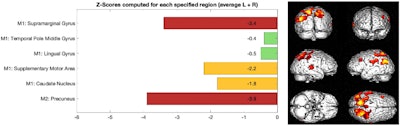
 Example of Alzheimer’s disease. (Left) Z-score bar chart for regions used in Model 1 and Model 2 classification. (Right) Statistical parametric mapping results outlining clusters of significant reduction in brain perfusion in the parietal lobe compared to a normal database.Journal of Alzheimer's DiseaseNext, the investigators tested the models on an independent test dataset of 443 patients, of whom 320 had abnormal scans and 183 had Alzheimer’s disease. Both models demonstrated good classification performance using real-world clinical data, the group reported. Model 1 achieved an area under the receiver operator characteristic (AUROC) curve of 0.89 (sensitivity 76%, specificity 87%) in identifying abnormal brain perfusion. Model 2 achieved an AUROC of 0.86 (sensitivity 87%, specificity 72%) in identifying Alzheimer’s disease.
“This study demonstrates the effectiveness of two logistic regression models in classifying brain perfusion abnormalities and [Alzheimer’s disease] using SPECT imaging data,” the researchers wrote.
The authors noted limitations, namely that generalizability to other clinical settings remains to be established. They wrote that external validation is planned using data from a partner hospital with different scanning equipment and imaging protocols. They also aim to engage with international collaborators, including groups in Japan with large perfusion SPECT cohorts, to evaluate the model's robustness across diverse populations and scanning conditions.
“Building on the findings of this study, future work will focus on evaluating the clinical impact of AI-based diagnostic support tools, particularly their influence on diagnostic accuracy, consistency, and clinical decision-making, comparing scenarios with and without the use of AI assistance,” Michopoulou and colleagues concluded.
The full study is available here.
Whether you are a professional looking for a new job or a representative of an organization who needs workforce solutions - we are here to help.