


About two-thirds of people living with dementia are women. One in four pregnancies worldwide involves first-trimester bleeding. Both numbers point to patient groups that radiology encounters every day, and still has no standard protocol for.
At ECR 2026, two researchers presented work that sits at that intersection: a national survey exposing the near-total absence of dementia training in Swiss mammography departments, and a three-phase doctoral study from Malta that built the first predictive model for threatened miscarriage outcomes in a country where first-trimester losses weren't even being recorded.
The findings came from the same session, and so did the gap.
Breast cancer risk rises in the same decade that dementia symptoms often first appear. Yet in Swiss mammography departments, that overlap has produced almost no formal response.
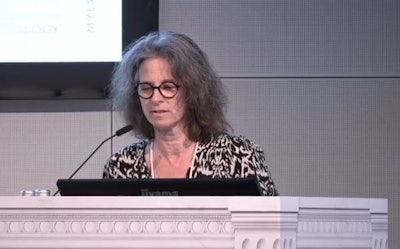
 "What is described in the literature with helping person with dementia cognitive disorder is gonna help all people," said Stephanie Frei, of the Haute École de Santé Vaud (HESAV) in Lausanne, Switzerland.Photo courtesy of Claudia Tschabuschnig
"The first symptoms of dementia often appear at the same age when breast cancer increases," said Stephanie Frei, of the Haute École de Santé Vaud (HESAV) in Lausanne, Switzerland, presenting her national survey at ECR 2026.
The numbers from that survey are stark: Of 243 radiographers working in mammography across Switzerland, only seven had received specific training in dementia-related care. At the same time, 82% said they needed it.
Practical and educational gaps
A person with dementia or cognitive disorder has specific symptoms and specific needs during care. This makes dementia care in mammography an image-quality issue. If a patient is anxious, confused, rushed, physically unstable, or unable to follow instructions, positioning suffers. If positioning suffers, image quality suffers. And if image quality suffers, cancer detection may too.
The gaps were practical as much as educational. "Only 20% of these radiographers are informed that the person who is coming has dementia, cognitive disorder," Frei noted.
Formal written procedures for this patient group existed in just 1.6% of departments. More than half of respondents, 51.8%, reported working in departments with non-uniform floors, raising concerns about accessibility and mobility before the examination has even begun.
Statistical differences in practice were visible across institution type, and by level of experience and education. Radiographers with more experience were somewhat more likely to apply adaptive strategies, but without formal training or protocols, individual improvisation is not a system.
Broader impact
Dementia-friendly breast imaging sits at the intersection of equity, aging policy, cancer screening quality, and workforce training. Concrete changes include longer appointment slots, pre-visit information from carers, clear one-step instructions, calm rooms, fewer staff changes, caregiver presence where appropriate, written protocols, and accessibility checks before the patient enters the room. Many of these cost nothing.
As Frei put it in discussion: "What is described in the literature with helping person with dementia cognitive disorder is gonna help ... all people."
A second ECR session turned to the first trimester. Threatened miscarriage, bleeding in a viable pregnancy, affects roughly one in four pregnancies worldwide. It is a major cause of maternal anxiety and frequent emergency visits.
"Despite advances in ultrasound technology, clinicians still lack reliable tools to predict which pregnancies will progress and which are more likely to end in miscarriage," said Lara Sammut, MSc, of the University of Malta in Msida, Malta.
A noninvasive, AI-enabled clinical decision support tool
Her doctoral research addressed that gap through a structured three-part design: a national retrospective cohort of 711 women presenting with first-trimester bleeding at Malta's main hospital, a scoping review of 128 international studies, and a prospective case-control study. The three-phase structure matters.
 "The first ever recorded pregnancy loss rate following confirmed threatened miscarriage in Malta," said Lara Sammut, MSc, of the University of Malta in Msida, Malta. Photo courtesy of Claudia Tschabuschnig
Phase one revealed that first-trimester losses were not being systematically recorded in Malta at all. National records only tracked births beyond 22 weeks. At the time of the study, there was no early pregnancy assessment unit in the country. Care was often expectant, with women given progesterone and told to wait for the next scan.
In the prospective phase, 118 women with threatened miscarriage and 59 controls were followed to term. The 23% pregnancy loss rate Sammut observed was, as she described it, "the first ever recorded pregnancy loss rate following confirmed threatened miscarriage in Malta," and it aligns with the worldwide rate of 20% to 30%.
Using random-forest machine learning alongside traditional logistic regression, the study identified the strongest predictors of outcome: progesterone, mean gestational sac diameter, trophoblast thickness, beta-hCG, crown–rump length, cervical length, maternal age, fetal heart rate, and the sFlt-1:PlGF ratio. The random forest model achieved 93.1% accuracy and an area under the curve (AUC) of 0.968, outperforming conventional statistics.
For women bleeding in early pregnancy, it makes the difference between waiting in fear and receiving a clearer, risk-based pathway. The work, Sammut said, lays the foundation for "a noninvasive, AI-enabled clinical decision support tool that can estimate miscarriage risk in real time." Malta has since opened an early pregnancy assessment unit. The study also contributed to national public consultations on miscarriage leave.
Whether you are a professional looking for a new job or a representative of an organization who needs workforce solutions - we are here to help.