


Newborns' livers can be affected by a variety of congenital and acquired diseases, and imaging plays an important role in the workup and management of these, according to a study published November 7 in RadioGraphics.
But it's crucial to choose the correct imaging modality, noted a team led by Fatemeh Hadian, MBChB, of the Hospital for Sick Children in Toronto, Canada. In a survey of imaging modalities available for this indication, the researchers outlined the pros and cons of using x-ray, ultrasound, MRI, and CT with newborn patients.
"Although they are rare, various congenital and acquired diseases can affect the neonatal liver," the group wrote. "Imaging has [a key] role in the workup and management of many neonatal hepatic abnormalities. For example, imaging is an important component of the workup in neonatal patients with liver failure, helps to narrow the differential diagnosis, and may allow the liver to be salvaged and transplant to be avoided through timely diagnosis of conditions such as neonatal hemochromatosis."
The team outlined the pros and cons of various modalities for neonatal liver imaging:
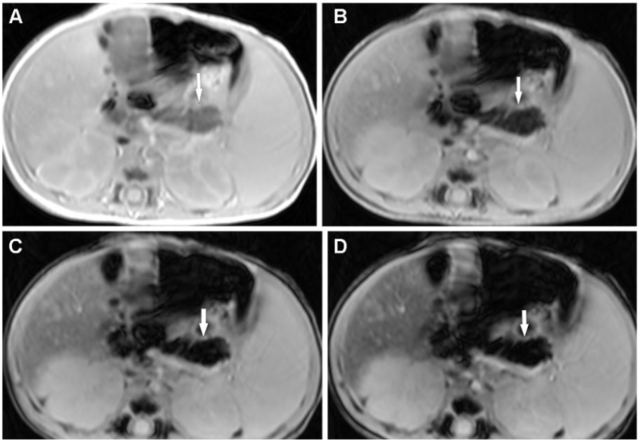
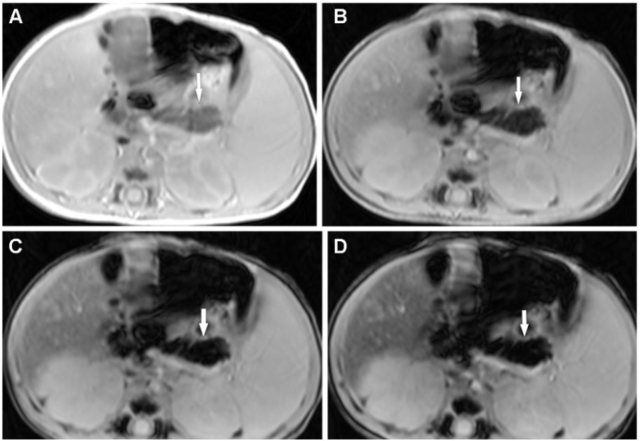 Neonatal hemochromatosis in a 25-day-old male neonate with neonatal liver failure. Axial MR images of the abdomen with echo times of 2.57 msec (A), 5.36 msec (B), 8.15 msec (C), and 10.94 msec (D) acquired with a 3T MR imaging unit show progressive low signal intensity of the pancreatic parenchyma (arrow) starting at the first echo, suggestive of marked pancreatic siderosis. There is also moderate iron deposition in the liver. Note the sparing of the spleen from siderosis, which is suggestive of neonatal hemochromatosis from gestational alloimmune disease. There is mild splenomegaly. This infant subsequently underwent a liver transplant. Images and caption courtesy of RadioGraphics.
In any case, it's important to keep in mind that since some findings on liver imaging are specific to neonates compared with those of older children, choosing the best modality to image the organ crucial, according to the authors.
"[Selecting] and tailoring the imaging techniques for each indication in neonates is important for optimal care with minimal invasiveness," they concluded.
The complete study can be found here.
Whether you are a professional looking for a new job or a representative of an organization who needs workforce solutions - we are here to help.