
The European Association of Nuclear Medicine (EANM) and the Society of Nuclear Medicine and Molecular Imaging (SNMMI) have released joint recommendations on the use of tau PET brain imaging in patients with suspected Alzheimer's disease.
The recommendations are intended to assist nuclear medicine practitioners in recommending, performing, interpreting, and reporting tau PET studies, according to a team led by corresponding author Matthias Brendel, MD, of University Hospital LMU Munich in Germany.
“Standardized imaging procedures are essential to ensure robust and reproducible measurements and to facilitate the integration of tau PET into clinical workflows and multicenter studies,” the authors wrote. The recommendations were published March 30 in The EANM Journal.
In Alzheimer’s disease, tau protein forms into neurofibrillary tangles in a predictable spatial pattern, and PET imaging has emerged as a key tool for visualizing these deposits in patients. Tau PET signal correlates closely with clinical severity and its topological distribution defines disease subtypes of Alzheimer’s disease, according to the researchers. Since tau PET has shown the ability to predict clinical progression, it is increasingly entering clinical routine workflows.
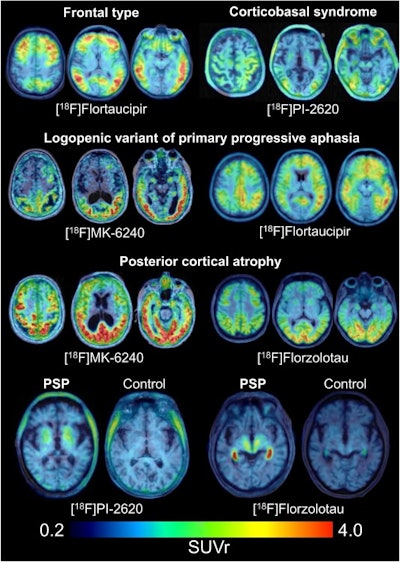
 Examples of tau PET patterns in atypical AD and 4R tauopathies. Three axial slices upon MRI or MRI template show radiotracer distribution in exemplary cases of atypical AD and progressive supranuclear palsy (PSP).The EANM JournalThe recommendations cover F-18 flortaucipir (Tauvid, Eli Lilly) -- the only currently approved tau PET radiotracer -- as well as several widely used next-generation tau PET radiotracers. They provide guidance on appropriate clinical indications, patient preparation, image acquisition, visual interpretation, and quantitative analysis. Particular emphasis is placed on harmonized procedures for image interpretation and quantification, including the use of standardized uptake value ratios (SUVRs), appropriate reference regions, and emerging harmonization approaches that enable comparison of quantitative measures across radiotracers and imaging centers.
Each guideline represents a carefully considered policy statement developed through an extensive consensus process and subject to extensive peer review, Brendel and colleagues noted.
The full article can be found here.
Whether you are a professional looking for a new job or a representative of an organization who needs workforce solutions - we are here to help.